Cleveland Heist Motorcycle

Cleveland Heist Motorcycle

Italian-American organized crime group

Cleveland crime family
Founded 1920; 101 years ago  (1920)
Founder Joseph "Big Joe" Lonardo
Founding location Cleveland, Ohio, United States
Years active 1920–present
Territory Primarily Greater Cleveland, with additional territory throughout Ohio as well as South Florida and Las Vegas
Ethnicity Italians as "made men" and other ethnicities as associates
Membership (est.) 60 made members (1950s)[1]
Activities Racketeering, murder, car bombing, drug trafficking, skimming, labor racketeering, extortion, illegal gambling, construction, garbage collection, loansharking, bookmaking, bribery, assault
Allies Chicago Outfit
Detroit Partnership
Gambino crime family
Genovese crime family
Kansas City crime family
Los Angeles crime family
New Orleans crime family
Pittsburgh crime family
Rivals Various local gangs

The Cleveland crime family or Cleveland Mafia is the collective name given to a succession of Italian-American organized crime gangs based in Cleveland, Ohio, in the United States. A part of the Italian-American Mafia (or Cosa Nostra) phenomenon, it operates in the Greater Cleveland area. Founded about 1920, leadership turned over frequently due to a series of power grabs and assassinations. Stability emerged in 1930 after Frank Milano became boss. The organization underwent significant decline in the last years of boss John T. Scalish. After his death in 1976, Irish mobster Danny Greene attempted to take over the Cleveland crime family. A violent gang war broke out which drew significant law enforcement attention. Significantly reduced in membership and influence, the Cleveland crime family nearly ceased to exist in the 1990s after a number of high-ranking members were imprisoned. The organization is believed by law enforcement to be extremely small in the 21st century, although attempting to rebuild.

History [edit]

Early organized crime in Cleveland [edit]

Semi-organized Sicilian American- and Italian American-run "Black Hand" extortion rackets first emerged in Cleveland about 1900. The Cleveland Division of Police soon established an "Italian squad" (also known as the "Black Hand squad") to deal with the problem. After a series of Black Hand-related murders in the city in 1906, this police unit largely suppressed this first expression of organized crime in Cleveland.[2] [a]

Loosely organized gangs emerged in the 1910s. An Italian American gang known as the Mayfield Road Mob formed in Cleveland's Little Italy neighborhood about 1913.[4] At roughly the same time, another Italian American gang, the Collinwood Crew, formed in the Collinwood neighborhood. This gang centered its activities around the intersection of St. Clair Avenue, E. 152d Street, and Ivanhoe Road.[5] Out of a drug store in Cleveland's Big Italy neighborhood,[6] [b] notary public Angelo Serra ran the "Serra Gang". It was primarily an automobile theft ring which relied on Serra to forge titles to the cars and create fake vehicle registration plates. At one point in the mid-1910s, it did $500,000 ($11,900,000 in 2020 dollars) a year in vehicle thefts. The gang also engaged in other crimes such as extortion, illegal gambling, the numbers racket, and robbery.[10] In the late 1910s, the "Benigno Gang" formed under Dominic Benigno in Little Italy. The gang specialized in payroll robberies, and in 1919 and 1920 monopolized payroll robberies by intimidating or murdering anyone who tried to pull off a heist without Benigno's permission.[11] [12] [c] A less organized and more fluid criminal organization was the "reservoir gang", a group of criminals engaged in armed robbery, automobile theft, burglary, and other property crimes which met at Cleveland's Baldwin Water Treatment Plant reservoir in order to plan crimes, exchange stolen goods, and disperse profits from crime.[13]

Prohibition began in Ohio on May 27, 1919,[14] and nationally throughout the United States on January 16, 1920.[15] Many small, organized gangs emerged between 1919 and 1921 to circumvent the liquor law by importing liquor from Canada, diverting alcohol from legitimate purposes (such as medicine and industry), and distilling and distributing home-brewed beer and liquor.[16] Small bootlegging operations were run by formerly legitimate businessmen like Michelino Le Paglia, August L. Rini, and Louis Rosen.[17] A number of small bootleg gangs, run by Jewish residents, began operating in the "Little Hollywood" area of the Hough neighborhood,[18] an area bounded by Lexington and Hough Avenues between E. 73rd and E. 79th Streets.[19] The brothels, gambling halls, and speakeasies of Little Hollywood became the favorite place to relax for small gang leaders throughout Cleveland, many of whom established their offices in the tiny red-light district.[18] Larger organizations included an Italian American gang centered on Woodland Avenue and E. 55th Street, and an Italian American gang centered on Woodland and E. 105th Street.[d] The Mayfield Road Mob also grew larger as it focused more on bootlegging.[16]

The Lonardo and Porrello brothers [edit]
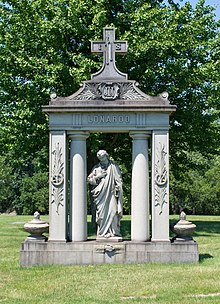
The Lonardo family plot at Calvary Cemetery in Cleveland, Ohio

The four Lonardo brothers (Joseph, Frank, John, and Dominic) and seven Porrello brothers, including Joseph Porello, immigrated to the United States from Licata, Sicily. The Lonardo and Porrello brothers first established themselves as legitimate businessmen. The two groups dabbled in various criminal activities including robbery and extortion, before prohibition, but were not yet considered a major organization.[20]

At the start of Prohibition, Joseph "Big Joe" Lonardo was the boss of the Cleveland crime family.[20] He was the second oldest of the four Lonardo brothers. He and his brothers began by supplying Cleveland's bootleggers with the corn sugar they needed to produce liquor. His top lieutenant was Joseph Porrello, who supervised various bootlegging and other criminal operations throughout the early to mid-1920s.

Split factions (1926–1927) [edit]

In 1926, the Porrello brothers (Rosario, Vincenzo, Angelo, Joseph, John, Ottavio, and Raymond) broke away from the Lonardo family and formed their own faction. They established their headquarters on upper Woodland Avenue, around E. 110th St. In 1927, hostilities between the Lonardo and Porrello families escalated as the families competed in the corn sugar business. During Prohibition, corn sugar was the prime ingredient in bootleg liquor.

In the summer of 1927, Joseph "Big Joe" Lonardo, boss of the Lonardo faction at the time, left for Sicily, Italy amongst rising tension between the two families. He left his brother John and adviser, Salvatore "Black Sam" Todaro as acting heads of the Cleveland family. When Lonardo returned, a sitdown was scheduled between the Lonardos and the Porrellos. On October 13, 1927, Joseph Lonardo and his eldest brother John were to meet with Angelo Porrello in a Porrello-owned barber shop. Inside the barbershop, when Joseph and John Lonardo relaxed into playing a game of cards, they were ambushed and killed by two Porrello gunmen.[21] [22] This allowed Joseph Porrello to take over as boss of the Cleveland crime family and become the most influential corn sugar baron in the Cleveland area.

The Porrellos (1927–1930) [edit]
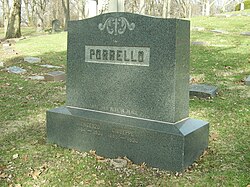
Through late 1927 and much of 1928, the remaining Lonardo faction loyalists, which included an up-and-coming Mafia group known as the Mayfield Road Mob (led by Frank Milano) and various Jewish allies within the Cleveland Syndicate, continued to rival the Porrello family for the leadership within the Cleveland underworld. They vied for control of the most lucrative rackets outside of the corn sugar business, which included gambling, the most profitable hustle for American Mafia crime families after bootlegging.

To establish dominance, the Porrellos needed backing from the top Mafia bosses in New York, as well as other leading Mafia families across the United States. On December 5, 1928, a high-level American Mafia meeting was held at the Statler Hotel in Cleveland. Joseph Porrello, with the help of one of his top lieutenants Sam Tilocco, hosted the event in hopes that the top Mafia bosses from across the United States would declare him the official Mafia boss of Cleveland.

The attendees of the Cleveland meeting became participants to one of the first known La Cosa Nostra summits in American history. Some of the powerful bosses who attended included Joe Profaci and Vincent Mangano of New York. However, the meeting turned into a fiasco as some of the well-known attendees were recognized by local law enforcement and arrested along with their associates. Meanwhile, Mafiosi continued to arrive from across the country for the Mafia summit.

The Porrello brothers arranged for their associates to be bailed out of jail. In spite of the chaos, Joseph Porrello was declared the boss and recognized nationwide as head of the Cleveland crime family. On June 11, 1929, Porrello family Lieutenant Sam Todaro was murdered.[23] At the end of Prohibition, most of the Porrello brothers and their supporters had been killed or had sided with the Mayfield Road Mob.

On July 5, 1930, Joseph Porrello was invited to a sitdown with Frank Milano at the Milano-owned Venetian Restaurant. Gunfire erupted and boss Joseph Porrello and his underling were killed. Vincenzo "Jim" Porrello succeeded his brother as Cleveland Mafia boss. Three weeks after his brother's murder, Vincenzo was shot in the back of the head and murdered in a grocery store on East 110th Street and Woodland Avenue in an area considered a Porrello stronghold. Raymond Porrello declared revenge, and on August 15, 1930, an explosion leveled Raymond's home. He was not home at the time.

Mayfield Road Mob (1930–1944) [edit]

In the early 1930s, Frank Milano and the "Mayfield Road Mob" of Cleveland's Little Italy had replaced the Porrellos as the Cleveland area's premier Mafia group. The Mafia faction was even mentioned by its old name in the movie The Godfather Part II as the Lakeview Road Gang, as Lakeview Cemetery borders Mayfield Road Hill which marks the beginning of Little Italy in Cleveland. This area is also referred to as "Murray Hill" by locals. This Mafia family was formed in the late 1920s and was headed by Frank Milano.

In 1931, Milano joined the National Crime Syndicate, a network of powerful criminals from around the country, such as Charlie Luciano and Meyer Lansky. Milano was now the official boss of Cleveland crime family. By 1932, Milano had become one of the top American Mafia bosses in the country and a charter Commission member.

On February 25, 1932, Milano made sure the Porrello family and their gang were finished for good by having Raymond and Rosario Porrello, along with their bodyguard, Dominic Gueli, murdered in a smoke shop on East 110th Street and Woodland Ave. in their old territory while they were playing cards. After this, the remaining Porrello brothers backed out of the Cleveland underworld and fled the area.

In 1935 Milano fled to Mexico after being indicted for tax evasion. Alfred Polizzi, another leading member of the Mayfield Road mob, seized power and reigned as boss until 1944 when he was convicted of tax evasion.

Collinwood Crew [edit]

The Collinwood Mob, also known as the Young Turks, was based in Cleveland's South Collinwood Neighborhood, was at times integrated with the Mayfield Road Mob and has a Mafia history as old as that of the Mayfield Road Gang. The most notorious of the Collinwood Crew was the late Alfred "Allie Con" Calabrese. Allie Con was feared and respected in both neighborhoods and known as a stand-up guy, a "true gangster". His crew consisted of Joe "Joey Loose" Lacobacci, the late Butchie Cisternino and others from an area that stretched from the 152nd Street bridge, up Five Points and Ivanhoe Road, down Mandalay across London Road to Wayside and over to Saranac bordering the Collinwood Train Yards.

Scalish era (1944–1976) [edit]

John Scalish held the longest reign of any Cleveland mob boss. He took control of the family in 1944, and remained the boss for thirty-two years, until his death in 1976. During his time as the crime family's leader, the group developed ties with important crime figures like Shondor Birns, Moe Dalitz, Meyer Lansky, and Tony Accardo. The Family also became allies of the extremely powerful Chicago Outfit and Genovese crime family. Additionally, The Cleveland mob also expanded its influence to areas throughout the Midwest, as well as California, Florida, and Las Vegas.

In the 1950s, the family reached its peak in size, with about 60 "made" members, and several times as many associates.[1] By the 1970s the family's membership began to decrease because Scalish didn't induct many new members. Scalish died during open heart surgery in 1976 and failed to name a successor beforehand.

War with Danny Greene and decline (1976–1990s) [edit]

FBI chart of Cleveland crime family in 1983

After the Death of John Scalish, it was decided by the family's members that James "Jack White" Licavoli would take over as boss. Licavoli worked for the infamous Purple Gang in Detroit during Prohibition before moving to Cleveland, where he gradually rose up the ranks of the city's underworld.

During his reign, an Irish gangster named Danny Greene began competing with the Mafia for control of rackets. This resulted in a violent mob war between the Mafia and the Danny Greene gang, during which there were almost 40 car bombings in Cleveland. This time period earned Cleveland the unofficial title of "Bomb City U.S.A.".[24] Danny was backed by mob associate and teamster John Nardi, who was killed on May 17, 1977, by a car bomb in the parking lot of the Teamster Hall in Cleveland.

After several failed attempts to kill Greene, it became evident that Licavoli's outfit needed outside help. In 1977, Danny Greene was murdered after a scheduled visit to his dentist. After learning of the dentist appointment scheduled by Greene, Licavoli and Lonardo contracted Ray Ferritto to assassinate him. While Greene was in the dentist's office, a bomb was placed underneath a car adjacent to his. Upon return to his vehicle the bomb was exploded remotely. Greene lay under the ruins of his vehicle for at least an hour before his corpse was removed.[25] After Greene's assassination, Ferritto heard that the Cleveland Crime Family wanted him dead and in response became an FBI informant. The information that he provided led to the arrests of many high ranking mafia members, including Jack Licavoli himself.

Eventually, Licavoli was sent to prison for the murder of Danny Greene in 1982. Angelo Lonardo, the son of Prohibition mob boss Joseph Lonardo, took control of the Cleveland crime family. He led the family until 1984 when he was convicted of running a drug ring and was sentenced to life in prison. He then became an informant, making him the highest-ranking Mafia turncoat up to that time. He informed on powerful Mafiosi from numerous families while in prison, and caused serious damage to the Mafia's infrastructure.

After Lonardo became an informant, the Cleveland crime family's boss was John "Peanuts" Tronolone. Peanuts was a long-time Miami Beach resident who prior to becoming the boss, was a South Florida point man for the New York-based Genovese crime family and other mobsters. He was also closely associated with Meyer Lansky. In 1989 he became the only Mafia boss to have the distinction of being arrested in a hand-to-hand undercover transaction by local law enforcement. He accepted jewelry from Dave Green, an undercover Broward County deputy in exchange for bookmaking and loan-sharking debts. He died before he could start his nine-year state prison sentence.

In 1978, Cleveland police warned then-mayor Dennis Kucinich that local Mafia members had put out a hit on him because of some of his mayoral initiatives were hindering money-making opportunities. Police told Kucinich that a hitman was planning on shooting the mayor while he marched in The Columbus Day Parade in October 1978. Kucinich missed the parade as he was hospitalized with a ruptured ulcer.[26] However, he took note of the threat and began keeping a gun in his home for protection.[27]

The Cleveland Mafia was dismantled by the FBI and other law enforcement officials so aggressively in the 1980s that by 1990 the family only had a few made members left in the street. According to the FBI the Cleveland Mafia started to slowly rebuild the organization by making new members in the late 1990s and all of the 2000s.[ citation needed ]

Historical leadership [edit]

Boss (official and acting) [edit]

  • 1920–1927 – Joseph "Big Joe" Lonardo – murdered in 1927.
  • 1927–1929 – Salvatore "Black Sam" Todaro – murdered in 1929.
  • 1929–1930 – Joseph "Big Joe" Porrello – murdered in 1930.
  • 1930–1935 – Frank Milano – fled to Mexico in 1935, moved to California in the late 1950s; died of natural causes in 1970.
  • 1935–1945 – Alfred "Big Al" Polizzi – arrested in 1944, retired to Florida in 1945, died of natural causes in 1975.
    • Acting 1944–1945 – John T. "John Scalise" Scalish - died of complications during heart surgery in 1976.
  • 1945–1976 – John T. "John Scalise" Scalish
  • 1976–1985 – James "Jack White" Licavoli – imprisoned in 1981, died of natural causes in 1985.
    • Acting 1981–1983 – Angelo "Big Ange" Lonardo – turned informant in October 1983, died of natural causes in 2006.
    • Acting 1983–1985 – John "Peanuts" Tronolone
  • 1985–1991 – John "Peanuts" Tronolone – died of natural causes in 1991
    • Acting 1991–1993 – Anthony "Tony Lib" Liberatore – imprisoned in 1993, died of natural causes in 1998.
  • 1993–2005 – Joseph "Joe Loose" Iacobacci – retired in 2005.
  • 2005–present – Russell "R.J." Papalardo[28]

Underboss [edit]

  • 1930–1976 – Anthony Milano – retired in 1976, deceased in 1978.
  • 1976 – Calogero "Leo Lips" Moceri – disappeared and murdered in 1976.
  • 1976–1983 – Angelo "Big Ange" Lonardo – turned informant in October 1983, deceased in 2006.
  • 1983–1985 – John "Peanuts" Tronolone – became boss in 1985.
  • 1985–1993 – Anthony "Tony Lib" Liberatore – served as acting boss 1991-1993, imprisoned in 1993, deceased in 1998.
  • 1993–1995 – Alfred "Allie" Calabrese – imprisoned in 1995.
  • 1995–2005 – Russel "RJ" Papalardo – became boss

Consigliere [edit]

  • 1930–1972 – John DeMarco
  • 1972–1973 – Frank "Frankie B" Brancato
  • 1973–1977 – Anthony "Tony Dope" Delsanter
  • 1977–1983 – John "Peanuts" Tronolone – became underboss in 1983.
  • 1983–1994 – Louis "Bones" Battista aka "The Bulldog" (deceased)
  • 1999–2010 – Raymond "Lefty" LaMarca (deceased 2010) [29]

Current made members [edit]

Administration

  • Boss – Russell "R.J." Papalardo[28]

Soldiers

  • John DiMariangeli
  • Ronald Lucarelli, Jr.
  • Russell Massetta
  • Carmine Minardi
  • Anthony Vollatta

Associates

  • Ronald Carabbia
  • James Martino

Former members [edit]

  • Pasquale Cisternino – died in 1990.
  • Joseph Iacobacci – powerful member of the family, serving as boss from 1993 to 2005. Iacobacci was able to partially rebuild the family, with the help of the Chicago Outfit. He died in April 2020.[30]
  • Milton "Maishe" Rockman [31] – Rockman was a Jewish-American organized crime figure affiliated with the Cleveland crime family.[32] Rockman was the brother-in-law of Cleveland crime family bosses John T. Scalish[31] and Angelo Lonardo, and was a top Cleveland crime family associate involved in labor racketeering and the Las Vegas casino interests of the Cleveland Mafia.[33]

References [edit]

Notes
  1. ^ "Black hand" murders continued into the 1920s.[3]
  2. ^ Now part of Cleveland's Central and Downtown neighborhoods, Big Italy ran along Woodland Avenue from Ontario Street/Orange Avenue in the west to E. 40th Street in the east. Initially Sicilian (with Italians coming after 1910), the Big Italy community formed about 1900. It was home to most of the city's wholesale and retail produce stores, and most residents worked as laborers and tradesmen. It began to decline significantly during the 1930s, and vanished in the 1940s as whites moved out and African Americans moved in.[7] [8] [9]
  3. ^ Cleveland crime historian Allan R. May says Benigno was the first head of the Mayfield Road Mob.[6] But Cleveland public prosecutor Frank J. Merrick said that after Benigno was executed in June 1922, there was no successor as head of the gang,[11] which makes the case for a distinction between the Benigno Gang and the Mayfield Road Mob.
  4. ^ These gangs existed prior to Prohibition, but were much smaller, less organized, and focused primarily on small-time crimes like auto theft, burglary, and the occasional raid of goods from unattended boxcars in railroad yards.[16]
Citations
  1. ^ a b Notable organized crime figures throughout Cleveland history (photos) Evan MacDonald, The Plain Dealer (July 29, 2015)
  2. ^ May 2014, p. 71.
  3. ^ Kelly, Ralph (December 26, 1933). "Murder in Cleveland: The Prohibition Toll. Chapter 1-The Bodies in the Snow". The Plain Dealer. pp. 1, 9.
  4. ^ Griffin & DeNevi 2002, p. 166.
  5. ^ McCarthy 2011, pp. 109–110.
  6. ^ a b May 2014, p. 67.
  7. ^ Bonocore 2005, p. 20.
  8. ^ Mitchell 2008, p. 7.
  9. ^ Miller & Wheeler 1997, p. 103.
  10. ^ May 2014, pp. 67, 76, 82.
  11. ^ a b Merrick, Frank J. (August 27, 1933). "Giving the Low-Down on Cleveland Rackets". The Plain Dealer. pp. Plain Dealer Magazine 3, 5.
  12. ^ May 2014, pp. 67–79.
  13. ^ May 2014, p. 171.
  14. ^ Birkhimer, Lily (June 1, 2012). "The Prohibition Era Begins". Ohio Memory . Retrieved August 22, 2018.
  15. ^ Anderson 2003, p. 96.
  16. ^ a b c Kelly, Ralph (December 27, 1933). "Murder in Cleveland: The Prohibition Toll. Chapter 2-Rosen and Adelson Got Better Publicity". The Plain Dealer. pp. 1, 5.
  17. ^ Kelly, Ralph (December 28, 1933). "Murder in Cleveland: The Prohibition Toll. Chapter 3—Rise of the Rum Kings; the 'Bloody Corner". The Plain Dealer. pp. 1, 5.
  18. ^ a b Kelly, Ralph (December 30, 1933). "Murder in Cleveland: The Prohibition Toll. Chapter 5—Death in Ambler Park: A Bootleg Joke". The Plain Dealer. p. 7.
  19. ^ Cleveland City Planning Commission (1991). Civic Vision 2000 Citywide Plan (PDF) (Report). Cleveland, Ohio. p. 92. Retrieved August 25, 2018.
  20. ^ a b DeVico 2007, p. 142.
  21. ^ "Two Brothers Murdered in Bootleg War". The Plain Dealer. October 14, 1927. pp. 1, 5.
  22. ^ "Hits New Lead in Murder of Two Lonardos". The Plain Dealer. October 15, 1927. pp. 1, 8.
  23. ^ Permanent Subcommittee on Investigations 1988, pp. 96–97. sfn error: no target: CITEREFPermanent_Subcommittee_on_Investigations1988 (help)
  24. ^ Petkovic, John (May 26, 2016). "The Cleveland Mafia: Death of a don ignites Bomb City, USA". The Plain Dealer . Retrieved June 23, 2017.
  25. ^ "Car bomb kills Danny Greene". The Plain Dealer. October 7, 1977. Retrieved June 23, 2017.
  26. ^ Renner, James (July 8, 2007). "The Mafia Plot To Kill Dennis Kucinich". The Cleveland Free Times. Archived from the original on July 8, 2007. Retrieved June 23, 2017.
  27. ^ Dubail, Jean (April 27, 2007). "Kucinich packed heat after 1978 Mafia death plot". The Plain Dealer . Retrieved March 26, 2018.
  28. ^ a b Martinelli 2011, p. 84.
  29. ^ "RAYMOND C. "Papa Duck" LaMARCA". Retrieved 29 November 2020.
  30. ^ "JOSEPH IACOBACCI Obituary (2020) - The Plain Dealer". obits.cleveland.com . Retrieved 2021-01-13 .
  31. ^ a b Whelan, Edward P. (February 15, 2011). "The Life and Hard Times of Cleveland's Mafia: How Danny Greene's Murder Exploded The Godfather Myth". Cleveland Scene . Retrieved August 23, 2018.
  32. ^ Koziol, Ronald (March 27, 1986). "Reputed Mob Boss Sentenced". Chicago Tribune . Retrieved August 23, 2018.
  33. ^ Cardarella, Toni (January 28, 1986). "Reputed mob figure Milton Rockman, who was held without..." United Press International . Retrieved July 16, 2018.

Bibliography [edit]

  • Anderson, Raymond G. (2003). "Beer". Alcohol and Temperance in Modern History: An International Encyclopedia. Volume 1. Santa Barbara, Calif.: ABC-CLIO. ISBN9781576078334.
  • Bonocore, Joseph (2005). Raised Italian-American: Stories, Values and Traditions From the Italian Neighborhood . New York: iUniverse. ISBN9780595357215.
  • DeVico, Peter J. (2007). The Mafia Made Easy: The Anatomy and Culture of La Cosa Nostra. Mustang, Okla.: Tate Publishing. ISBN9781602472549.
  • Griffin, Joe; DeNevi, Don (2002). Mob Nemesis: How the FBI Crippled Organized Crime. Amherst, N.Y.: Prometheus Books. ISBN9781573929196.
  • Martinelli, Patricia A. (2011). True Crime: The State's Most Notorious Criminal Cases. Mechanicsburg, Pa.: Stackpole Books. ISBN9780811744409.
  • May, Allan R. (2014). The Sly-Fanner Murders: The Birth of the Mayfield Road Mob, Cleveland's Most Notorious Mafia Gang. Cleveland: Con-Allan Press. ISBN9780983703747.
  • McCarthy, Dennis M.P. (2011). An Economic History of Organized Crime: A National and Transnational Approach. New York: Routledge. ISBN9780415487962.
  • Miller, Carol Poh; Wheeler, Robert A. (1997). Cleveland: A Concise History, 1796-1996. Bloomington, Ind.: Indiana University Press. ISBN9780253211477.
  • Mitchell, Sandy (2008). Cleveland's Little Italy. Charleston, S.C.: Arcadia Publishing. ISBN9780738552132.
  • Porrello, Rick (1995). The Rise and Fall of the Cleveland Mafia: Corn, Sugar, and Blood. New York: Barricade Books. ISBN9781569800584.
  • Porrello, Rick (2004). To Kill the Irishman: The War that Crippled the Mafia. Novelty, Ohio: Next Hat Press. ISBN9780966250893.

Cleveland Heist Motorcycle

Source: https://en.wikipedia.org/wiki/Cleveland_crime_family

Share:

2014 Triumph Thunderbird Lt

2014 Triumph Thunderbird Lt

2014 Triumph Thunderbird LT Review

6-15-2014

by Pascal Bastien , moto123.com

The new 2014 Triumph Thunderbird LT has all the segment's big guns square in its sights, including the Victory Cross Road and Harley-Davidson Road King. The British manufacturer thought everything through, and the result is an impressive combination of styling, comfort, and mechanical thrills.

2014 Triumph Thunderbird LT powertrain: Simply a great match
It all starts with a 1,699cc parallel twin-cylinder which perfectly suits the nature of the 2014 Triumph Thunderbird LT. Powerful and charismatic, not to mention devoid of unpleasant vibrations, this engine boasts lightning-quick throttle response, and propels the 380kg beast with disconcerting ease.

With is juiced-up twin, the 2014 Triumph Thunderbird LT feels so much more aggressive than light-touring cruiser stereotypes would have you believe. Forget about weight and power figures; it's the massive amount of torque that makes the big steed come alive at just 1,500 rpm, and then catapults you from 2,500 to 4,000 rpm.

The 8-valve, DOHC engine is both feisty and flexible, pinning you to the back of your seat at each twist of the throttle. Similar to its 1,600cc predecessor, it uses a 270-degree firing interval to create a dynamic feel. Classic big-twin sounds and thrills add to the excitement of riding the 2014 Triumph Thunderbird LT, while the smooth operation enhances comfort. There's a price to pay at the pump, however, as fuel economy is below average (at least it was in the case of my tester, which wasn't quite broken in yet).

2015 Triumph Thunderbird LT engine
It all starts with a 1,699cc parallel twin-cylinder which perfectly suits the nature of the 2014 Triumph Thunderbird LT. (Photo: France Ouellet)

Attacking the road with the 2014 Triumph Thunderbird LT
With your arms extended, your butt mistaking the rider's seat for a couch, and your feet resting on large boards, it's easy to sit back and relax as you enjoy miles and miles of open road. The only thing missing here is cruise control. In typical cruiser fashion, the clutch lever is still manly to use, while the very long final gear ratio helps reduce engine revs and fuel consumption at highways speeds.

Built on a rigid, stable frame, and equipped with a nice set of brakes, the 2014 Triumph Thunderbird LT is designed to let the engine reveal its spirited character. Front nosedive and rear tail-whipping are nil, while ground clearance is generous enough to give you the impression of riding a sporty cruiser. Whereas many competitors are all show and no go, the Thunderbird LT proves quite balanced and relatively agile around town for such a big bike. Sure, the large turning radius makes parking a bit harder, but this British hero is still pretty easygoing at low speeds, and a lot less intimidating to ride than to look at.

2014 Triumph Thunderbird LT 3/4 view
With your arms extended, your butt mistaking the rider's seat for a couch, and your feet resting on large boards, it's easy to sit back and relax as you enjoy miles and miles of open road. (Photo: France Ouellet)

2014 Triumph Thunderbird LT is geared for the long haul
Fancy a long-distance trip? The Thunderbird LT has you covered with decently sized saddlebags, a tall windshield that's easy to remove and just angled enough to limit head buffeting, as well as a perfectly sculpted seat that provides good support.

As for styling, the gorgeous 2014 Triumph Thunderbird LT will easily attract fans of touring-oriented cruisers. Fit and finish are impeccable, and the comprehensive array of stylish features makes me wonder how Triumph could possibly envy any other brand.

2014 Triumph Thunderbird LT side view
As for styling, the gorgeous 2014 Triumph Thunderbird LT will easily attract fans of touring-oriented cruisers. (Photo: France Ouellet)

Summing up the 2014 Triumph Thunderbird LT
Before you go out and buy your next touring motorcycle, you must take this new Triumph for a spin. Charismatic, comfortable, and capable, the 2014 Thunderbird LT is one of the year's best surprises.

Pros

  • All the ingredients that customers want
  • Very easygoing for such a big bike
  • Sweet and spirited engine

Cons

  • Below-average fuel economy
  • Large turning radius makes parking a bit harder

2014 Triumph Thunderbird Lt

Source: http://www.moto123.com/motorcycle-reviews/article,2014-triumph-thunderbird-lt-review.spy?artid=168518

Share:

2016 Vw Golf Apple Carplay

2016 Vw Golf Apple Carplay

UK pricing gives us a good idea of how much it will cost us stateside.

Volkswagen has been hard at work bringing new models to the international market, and while focus has been on eco-friendly all-electric models, it hasn't neglected its hardcore sports car fans. The high-performance Golf R recently broke cover with an impressive 315 horsepower, making it the most powerful production Golf yet. Orders for the new Golf R and its sibling the GTI Clubsport have opened in the UK and join the already impressive VW performance lineup, including the GTI, GTD, and GTE. While pricing for the US Golf R is yet to be announced, UK customers have received the bill.

Front Angle View Volkswagen

Rear Angle View Volkswagen

In the UK, the new Golf R will sell for £39,270 ($52,852). The 2019 model sold in the US started at $40,295, and the current Golf GTI will cost you $27,595, so US buyers can expect a price tag of around $45,000. Sarah Cox, Head of Marketing at Volkswagen UK, said: "Christmas has come early for fast Volkswagen fans, with not just one performance hero opening to UK customers today, but two. UK buyers love hot hatchbacks like the Golf R and GTI, and these cars will represent a considerable share of all new Golf sales. I can't wait to order one myself!" she said.

Dashboard Volkswagen

Front Seats Volkswagen

Central Console Volkswagen

The new Golf R is powered by the advanced EA888 evo4 engine which sends 315 hp to all four corners via a seven-speed DSG transmission, and Volkswagen's 4MOTION all-wheel-drive system. The performance figures speak for themselves: The 0 to 62 mph sprint is completed in 4.7 seconds, making it the fastest accelerating production Golf in the history of Golfs. As if this car isn't fast enough, Volkswagen will be offering the R with an optional R-Performance Package for £2,000 ($2,692) which adds upgraded 19-inch 'Estoril' alloy wheels, a bigger rear spoiler, and an increased top speed of 168 mph. The Golf R is rapid, but at $43,000, the 2020 Audi S3 is cheaper and quicker.

Frontal Aspect Volkswagen

Aft View Volkswagen

2016 Vw Golf Apple Carplay

Source: https://carbuzz.com/news/the-new-vw-golf-r-has-an-official-price-tag

Share:

2011 Kawasaki Voyager Review

2011 Kawasaki Voyager Review

Back to 2011 Kawasaki Motorcycle Index Page

Click photos to enlarge.
They make great desktop images.

2011 Kawasaki Vulcan 1700 Voyager

2011 Kawasaki Vulcan 1700 Voyager

2011 Kawasaki Vulcan 1700 Voyager

2011 Kawasaki Vulcan 1700 Voyager

2011 Kawasaki Vulcan 1700 Voyager

2011 Kawasaki Vulcan 1700 Voyager

– 2011 Kawasaki Vulcan 1700 Voyager

2011 Kawasaki Vulcan 1700 Voyager

Classic Good Looks in a Big-rig Tourer That Does It All

Horizon-chasing touring bikes are nothing new to Kawasaki. The original Voyager® and the sport-touring Concours™ models have been pulling long-haul duty wonderfully for decades now. But not until 2009 did Team Green bless its V-twin cruiser with the full-dress accoutrements necessary to go across the state – or across the country – in wraparound, top-shelf comfort. The result was the Vulcan® 1700 Voyager, a tourer that could not only whisk you and a passenger away in total comfort, but in classic style, too.

As the flagship of the Vulcan 1700 family, the 2011 Voyager boasts all the stuff you'll need for such adventurous treks: a smooth and shockingly torquey 1,700cc V-twin powerplant, large frame-mounted fairing, beautifully integrated luggage that stows a week's worth of gear, a comfortable saddle, electronic cruise control, high-fidelity sound system, optional K-ACT anti-lock/integrated braking system and the sort of design acumen and dependability Kawasaki is renowned for. It's a package without equal in the motorcycling world.

Though a non-ABS model is available, last year, Kawasaki upgraded the 1700 Voyager's driveline/braking technology with the addition of its second-generation Kawasaki Advanced Coactive Braking Technology (K-ACT) system. Available on the ABS-equipped Voyager, K-ACT uses advanced electronics to translate the rider's braking inputs from both the front lever and rear pedal into smooth, balanced deceleration and maximum stopping performance. Basically, the front lever also activates the rear brake, and the rear pedal also engages the right front caliper: K-ACT ensures all this happens seamlessly and efficiently, and the, second-generation system uses the same smaller, lighter ABS unit and faster, higher-spec brake ECU found on the Kawasaki Concours™ 14 ABS motorcycle for even smoother, more precise operation. K-ACT's coactive function does not engage when braking is applied at speeds below 12 mph, and the ABS function is automatically disengaged at speeds below 4 mph.

There's much more on the unique technology front, including Kawasaki's fully electronic throttle valve system, which works in concert with the Voyager's Electronic Fuel Injection (EFI) system to enhance engine response without dulling the big Vee's distinctive throb. The system also helps the ECU deliver ultra-precise air/fuel metering and more accurate idle speed control. The setup utilizes an Accelerator Position Sensor (APS) and Throttle Position Sensor (TPS) that feed data to the ECU, which adjusts the throttle plates to tailor intake airflow accordingly. The system offers natural throttle feel, as APS is activated by a throttle-body pulley connected by cables to the throttle grip.

The 1,700cc 52-degree V-twin all of this cool technology was designed to support is a marvel of engineering, and is as functionally capable as they come. Featuring liquid cooling, four-valve cylinder heads and a single overhead cam setup for big-time mid-range power, the engine utilizes a pair of big pistons to pump out a massive quantity of torque over an unbelievably wide rpm range – a key to this engine's superb flexibility. There's a boatload of the stuff located throughout the rpm zone where riders will spend the most time—and more than enough from idle all the way to 5,000 rpm, so major-league, arm-straightening thrust is available right now every time you twist the grip.
The Voyager's fuel injection and exhaust systems are tuned to deliver peak torque and horsepower at slightly higher rpm than the Classic models, which is optimal for an open-road tourer. The Voyager's mufflers have been redesigned for 2011 for improved sound quality and a more tapered, classic look. Other changes for 2011 are improved shifting action, revised intake manifold and a slight EFI tweak that improves throttle response by matching up more optimally with the newly designed mufflers. Additional touring functionality is provided by the Voyager's beefy but easy-to-squeeze clutch, which features six damping springs and progressive three-stage engagement for easier shifting under hard acceleration.

The Voyager's innovative technology is matched with essential touring features such as electronic cruise control and a six-speed transmission with overdrive fifth and sixth gears. The cruise control is conveniently operated from the right handlebar and can be activated between 30 and 85 mph in any of the top four gears. Conveniently, the cruise control can be disengaged by pressing the brake lever, clutch lever, rear brake pedal, or by manually rolling off the throttle.

Featuring overdrive ratios and a super strong carbon fiber drive belt, the Voyager's drivetrain is ideally suited to its role as a relaxed mile-eater. Its tall fifth and sixth gears contribute to relaxed riding and better fuel economy at highway speeds, and its carbon fiber drive belt has a 40-percent higher tensile strength than the latest Kevlar units, allowing use of a 28mm design that minimizes drivetrain width.

A long-haul tourer needs superior wind and weather protection, and the Voyager packs plenty in the form of its large frame-mounted windshield and fairing, as well as leg shields that incorporate effective venting to keep engine heat off the rider's legs during slower going. Mounting this beautifully sculpted fairing to the frame transfers any wind buffeting to the bike rather than the handlebar, which reduces rider fatigue on longer trips.

A full complement of stylish and integrated luggage is also part of the Voyager package. Sealed, lockable and top-opening side cases with 10 gallons (38L) of volume partner with a color-matched, 13.2-gallon (50L) lockable tail trunk that's big enough to swallow two large full-face helmets. Besides ample storage, the Voyager also has a pair of lockable glove boxes up front that provide a handy place for storing small items and accessories.

Comfortable seating for rider and passenger is a must on a touring bike. The Voyager delivers again with deluxe touring seats sculpted to provide additional support for all-day touring. Contributing to long-distance passenger security and relaxation are a luxury backrest and floorboards for both the rider and passenger.

Built-in instruments and radio controls mounted on the Voyager's classic automotive-style dash offer exceptional functionality and classic muscle car styling. The image is reinforced by the classic font used on the large round dials of the instrumentation and a radio styled to resemble 8-track players from the 1960s.

A multi-function LCD display is mixed in with the retro analog dials in the center of the instrument console. It's controlled by switches on the right handlebar and features a gear-position indicator, clock, odometer, dual trip meters, remaining range and average fuel consumption.

The intercom headset-compatible, 40-watt, twin-speaker audio system features a three-band (FM/AM/WX) radio that is also compatible with iPods, an XM radio tuner, or a CB radio unit. The audio system (and iPod) can be operated by an integrated controller on the left handlebar. In addition to volume, the rider can also adjust the bass, treble and balance levels of the system.

The Voyager also features a water-cooled, rare earth magnet alternator that produces an impressive 46.8 amps of electrical output – enough to power add-on navigation systems and other electrical accessories that add to the modern touring experience. The Voyager also features a convenient cigarette lighter-style power port on the dash and two power outlets under the seat – ideal for electrically heated clothing and additional accessories.

Kawasaki designers packed the Voyager with advanced technology without dulling its dramatic styling and attractive visual appeal. Like the dashboard, the Voyager's bodywork continues the '60s muscle car inspiration with its curved, muscular lines. The meticulous attention to detail and exquisite craftsmanship of the bodywork and engine covers is obvious in contoured shapes that look good from any angle and are as pleasing to the touch as they are to the eye.
The Voyager handles like a much lighter machine thanks to optimal chassis design and excellent suspension. Dual air-shocks offer 3.1 inches of rear suspension travel and feature settings unique to the Voyager. The shocks feature 4-way rebound damping adjustability to help ensure predictable handling and a comfortable ride.

Offering a stylish alternative to other run-of-the-mill V-twin tourers, the Vulcan 1700 Voyager combines Kawasaki reliability with the performance, V-twin feel, comfort and amenities long-distance touring riders demand.

Authentic Kawasaki Accessories are available through Kawasaki dealers.

2011 Kawasaki Vulcan 1700 Voyager motorcycle model Features

Details & Features

New For 2011

– Redesigned mufflers offer improved sound quality and feature a more tapered, classic look
– Improved and quieter shifting action via revised 1st gear ratio and taller teeth on the third and fourth gears
– Improved EFI settings that match the new muffler assemblies more accurately

Key Features

– Powerful 1,700cc liquid-cooled V-twin delivers high levels of torque
– Six-speed transmission for relaxed cruising
– Electronic cruise control maintains speed for more comfort on long trips
– Frame-mounted fairing provides stylish wind protection to the rider and passenger
– Feature-rich audio system comes standard, has AM/FM/WB, and is compatible with iPods and XM radio
– Color matched trunk is big enough to hold two full-face helmets
– Lockable, color matched, top-opening hard saddlebags are capacious and easy to pack from the top
– Low 28.7-inch seat height enhances the comfortable riding position
– Compact and upright ergonomics for all-day rider comfort

2nd Generation Kawasaki Advanced Coactive-Braking Technology (K-ACT) ABS

– Voyager ABS models feature the latest, fastest version of Kawasaki's sophisticated K-ACT system, which enables riders to execute controlled, balanced braking. Designed to complement the riders' brake inputs, the system distributes the ideal amount of brake pressure to maximize braking efficiency
– Low battery mode maintains ABS function while reducing signal frequency to conserve power when needed
– For controllability in tight corners and when executing U-turns, K-ACT's coactive function does not engage when braking is initiated at speeds below 12 mph
– ABS function is disengaged at speeds below 4 mph
– Both ABS and non-ABS models use dual 300mm front disc brakes with four-piston calipers and a two-piston rear disc brake for sure, powerful stops

Powerful 1,700cc V-twin engine

– Liquid-cooled, four valves per cylinder, fuel-injected 1,700cc 52-degree V-twin engine
– Long-stroke 102 x 104mm bore and stroke dimensions help deliver high levels of torque – approximately 15 percent greater than that of the Vulcan 1600, with a distinctive V-twin feel
– Valve system is based on the Vulcan 2000's, but uses a single overhead cam arrangement instead of pushrods for quicker revving and enhanced mid
– to high-rpm power
– Semi-dry sump allows a lower crankshaft placement and a longer piston stroke without increasing engine height
– Single-pin crank accentuates the engine's V-twin character by providing stronger power pulses
– Large capacity airbox is located on both sides of the engine
– Small-diameter iridium sparkplugs reach deep into the combustion chamber for high combustion efficiency, especially during low-load operation
– Dual mufflers, one on each side of the bike, allow maximum clearance for luggage
– Engine tuning offers superior acceleration in the 50 to 70 mph range
– Even in overdrive, the engine pulls strongly in this speed range, facilitating overtaking at highway speeds

Fuel Injection

– Based on the systems used by the Ninja® 650R and Vulcan 900
– Utilizes one sensor in place of the usual three for reduced complexity and weight
– The touring-oriented Voyager utilizes FI and exhaust systems tuned to reach peak torque and horsepower at a higher rpm than the engines used in standard Vulcan 1700 cruisers

Electronic Throttle Valve System

– Fully electronic throttle actuation system enables the ECU to control the volume of intake air (via throttle valve angle) and fuel (via fuel injector timing) delivered to the engine
– Optimized fuel injector timing and throttle valve position results in accurate, powerful engine response
– Control of both fuel injection and airflow provides easy starting and precise cold-engine idle speed control
– From the rider's perspective, the ETV works like a standard cable-operated throttle; the throttle grip is still connected to cables, so the feel at the grip is the same
– Twisting the throttle turns a pulley on the throttle body which triggers the Accelerator Position Sensor (APS) to send a signal to the ECU, which then modulates the throttle valves via a DC motor
– Accurate throttle position is relayed to the ECU by a Throttle Position Sensor (TPS)
– APS and TPS send two sets of signals to the ECU for system redundancy in the unlikely event of a sensor failure

Cruise Control

– Cruise control can be engaged and adjusted entirely from the right handlebar
– Cruise control can be activated in 3rd gear or above at any speed between 30 mph and 85 mph
– Pressure on the brake lever, clutch lever or rear brake pedal automatically disengages the cruise control, as will manually rolling off the throttle

On Board Diagnostics

– Diagnostic system allows self-testing of the electronic systems on the Vulcan 1700
– Display codes on the instrumentation can be read by owner using accessory manual

Six-speed Transmission / Final Drive

– Both 5th and 6th gears are "overdrive" ratios, which contributes to stress-free riding and better fuel economy when cruising at highway speeds
– 28mm carbon fiber final drive belt offers a 40-percent increase in tensile strength compared to current Kevlar belts. This allows the Vulcan 1700 to use a slim belt only 2mm wider than the Kevlar unit on the Vulcan 900
– Belt drive system is quiet, efficient and offers reduced maintenance compared to a chain

Light Handling Chassis

– A more compact package than its predecessors, the Voyager has a shorter wheelbase and shorter distance between the seat and steering head, for improved rider ergonomics and easier maneuverability
– Designed to be as light and slim as possible, the frame minimizes the number of forged parts and trims any unnecessary metal. The only forged parts are areas that require additional strength – the down-tube joint, engine brackets, side-stand bracket, and rear fender/shock absorber bracket
– The compact design contributes to light handling and facilitates handling at low speeds, especially when executing precise slow-speed maneuvers like parking or making U-turns

45mm Telescopic Fork

– Provides superb steering feedback
– 5.5 inches of travel helps provide excellent ride quality

Dual Adjustable Rear Air Shocks

– Features air-adjustable spring preload to help compensate for passenger and luggage variations
– 4-way rebound damping adjustments help the shocks compensate for changes in spring pressure
– Voyager-specific settings match the load carrying and long distance touring requirements inherent in this type of motorcycle

9-Spoke Cast Wheels

– Allow the use of tubeless tires and complement the Voyager's muscular styling
– 130/90 front and 170/70 rear tires offer optimal traction and wear characteristics
– Tire choice and suspension settings augment the chassis' light handling characteristics

Classic V-twin Appeal

– Basic architecture has a significant impact on a V-twin engine's appearance
– The line created by the top of the airbox and the cylinder heads forms a curved shape that continues to flow through the bike
– Deeply chromed engine covers have curved upper surfaces. Their three-dimensional form adds volume and gives a quality appearance
– The edges of the cooling fins receive a special NC treatment that makes them gleam in sunlight
– All the non-chromed parts of the engine have a matte black finish that further accentuates the chromed parts

Bodywork

– Muscular fairing is reminiscent of classic American muscle cars in its sculpted, flowing design
– Chromed headlamp cover and twin fog lights contribute to the muscle car theme
– The fuel tank's hand-sculpted contours employ constantly varying radii, giving the bike a dynamic flow that is pleasing both to the eye and to the touch
– The lines flowing through the rest of the bike and its elegant fuel tank contribute to the Voyager's curvaceous figure
– Liberal use of chrome contrasts nicely with the bodywork's deep, lustrous paint. The engine, front and rear guards, accents on the side cases and trunk, and the trunk brackets are fully chromed
– Design motif from the front fender continues on the rear fender, which features an elegant LED taillight
– Front and rear guards help protect the bike's bodywork in case of a tip-over
– Dual 35W fog lights have a dedicated On/Off switch and can be adjusted vertically
– In addition to the taillight on the rear fender, the Voyager also has a large, highly visible LED taillight mounted on the rear of the trunk that contributes to its appearance

Classic Retro Dashboard

– Instrument layout and large round dials give the Voyager's console a classic automotive elegance, which is reinforced by the font used in the instrumentation
– Even the radio has a classic look, reminiscent of the 1960s
– Multi-function LCD display in the center of the instrument console is controlled by switches on the right handlebar. Features include a gear position indicator, fuel gauge, clock, odometer, dual trip meters, remaining range and average fuel consumption
– Analog displays include speedometer, tachometer and coolant temperature gauge
– Audio system with twin speakers features radio (FM/AM/WX) and compatibility with optional iPod®, XM tuner or CB radio units
– The audio system (and iPod) can be operated by switches on the left handlebar
– Ignition switch allows key removal in the on position; preventing keys from damaging the chrome finish around the ignition area during operation
– Turning the ignition switch collar to the ACC position allows accessories to be used while the engine is off and turning it to the "OFF" position turns the engine off and necessitates re-insertion of the key to restart

Wind Protection

– Large windshield and fairing help protect the rider and passenger from wind and elements
– With the front fairing mounted to the frame, any wind buffeting is transferred to the bike rather than the handlebar, helping to enhance highway stability and reduce rider fatigue
– Leg shields have adjustable vents to tailor the amount of airflow to the rider's legs

Ample Storage

– 13.2-gallon (50L) lockable trunk is large enough to fit two full-face helmets
– Top-opening side cases are sealed and lockable, with a volume of 10 gallons (38L) each
– Up front, lockable glove boxes provide a handy place for storing small items and accessories. An iPod jack (optional connector required) is located in the left-side glove box

Comfort

– Sculpted seat designed for both long-distance ergonomics and an easy reach to the ground
– Upright riding position and floorboards contribute to all-day touring comfort
– Roomy passenger seat is complemented by padding on the trunk that provides back and arm support
– Rear floorboards contribute to passenger comfort
– Dual adjustable rear air shocks use settings optimized for load carrying and long-distance comfort

Long Range

– 5.3-gallon fuel tank offers a substantial range, helping to minimize fuel stops when out on the open road

2011 Kawasaki Vulcan 1700 Voyager motorcycle model Technology

Engine

Newly designed engine offers both significant power and torque gains and superior passing performance. The 1700cc engine is mounted in a new frame designed for light weight and light handling. The Voyager's compact package offers ease of manoeuvrability.

Powerful 1700cc V-Twin engine

Long-stroke, liquid cooled, SOHC, 8-valve 1,700 cc V-Twin engine was designed to deliver high levels of torque. Bore and stroke measure 102 x 104 mm. Torque is approximately 15% greater than that of the VN1600D.

Valve system uses a SOHC arrangement instead of OHV for more direct engine feel and easier merging onto freeways.

Large capacity airboxes are located on either side of the engine.

Twin mufflers (one on each side) are based on the same construction as those on the VN2000.

Semi-dry sump (like that on the VN2000) allowed the crankshaft to be lowered, enabling a longer stroke without increasing engine height.

Both pistons are connected to a single crankpin. Primary balance is satisfied care of two counter-balance shafts.

Small-diameter iridium spark plugs reach deep into the combustion chamber for high combustion efficiency, especially at low-load operation (near idling).

Belt final drive is quiet and efficient and helps reduce maintenance chores. Using carbon fibre instead of Kevlar as a tensile material, the belt offers high strength (tensile strength is increased by 40%) with a slim size and light weight. Belt width (28 mm) is more comparable to that of the VN900 models (26 mm) than that of the VN2000 (40 mm).

The clutch features six damping springs for 3-stage progressive damping that contributes to smoother feeling when getting back on the gas.

Superior passing performance

Engine tuning offers superior acceleration in the 80-113 km/h (50-70 mph) range. Even in overdrive, the engine pulls strongly in this speed range, facilitating overtaking at highway speeds.


Transmission

6-speed transmission with overdrive

6th gear is an overdrive gear, contributing to stress-free riding and better fuel economy when cruising at highway speeds.


Handling

Light handling

Designed from the start to be as light and slim as possible, the frame minimises the number of forged parts and trims any unnecessary meat. The only forged parts (the down-tube joint, engine brackets, side-stand bracket, and rear fender/shock absorber bracket) are areas that require additional strength. The new frame is lighter than that of the VN1600A, with greater torsional rigidity.

More compact in design, the VN1700 has a shorter wheelbase than both the VN2000 and VN1600. The compact design contributes to light handling.

Shorter distance between the seat and frame head pipe facilitates handling at low speeds, especially when executing U-turns.

Mounting the front cowling to the frame rather than the handlebars contributes to light handling when manoeuvring at low speeds.

Tire choice and suspension settings also contribute to the light handling.

Styling

Kawasaki Cruisers have always been a showcase of craftsmanship and attention to detail. The Vulcan 1700 Voyager is no exception. With 60s-era American sports cars as a design theme, all surfaces have a muscular curvature that flows from one end of the bike to the other. Like on the VN2000 models and VN900 models before them, design of the engine covers and bodywork on the Vulcan 1700 models received meticulous care to ensure the bikes not only look good from any angle, but also that their elegant form is as pleasing to the touch as to the eye.

Engine

Basic engine structure has a great impact on a V-Twin engine's appearance. Using a semi-dry sump enabled the engine's long-stroke configuration without increasing its height.

The line created by the top of the airbox and the cylinder heads forms a curved lined that continues to flow through the bike.

Deeply chromed engine covers have curved upper surfaces. Their three-dimensional form adds volume and gives a quality appearance.

The edges of the fins receive a special NC treatment that makes them gleam in sunlight.

All the non-chromed parts of the engine have a matt black finish that further accentuates the chromed parts.

Slim design of the belt drive contributes to appearance.

Bodywork

Muscular front cowling is reminiscent of American sports cars in its sculpted, flowing design. Chromed headlamp cover and twin fog lights contribute to the look.

The elegantly shaped fuel tank tapers at the rear, contributing to the Vulcan 1700's curvaceous figure, its lines flowing through the rest of the bike. The fuel tank's curves have constantly varying radii, giving the bike a dynamism that is both powerful and sexy. Its hand-sculpted contours are pleasing both to the eye and to the touch.

Kawasaki craftsmanship is also evident in the styling motif of the front fender.

Liberal use of chrome contrasts nicely with the bodywork's deep, lustrous paint. In addition to the engine, the front and rear guards are chromed, as are the accents on the panniers and trunk. Even the trunk brackets are fully chromed.

Motif from the front fender continues on the rear fender.

The Vulcan 1700 Voyager is the first Kawasaki V-Twin tourer to feature an elegant LED taillight.

In addition to the taillight on the rear fender, a large LED taillight mounted on the rear of the trunk is highly visible and contributes to the Vulcan 1700 Voyager's appearance.

Dashboard

Instrument layout and large round dials give the Vulcan 1700 Voyager's console a classic automotive appearance. This image is reinforced by the font used on the instrumentation. Even the radio has a classic look, reminiscent of 8-track p

Comfort and Convenience

Cruise control

Operation of the cruise control is conveniently from the right handle.

Cruise control can be activated between 47 km/h (30 mph) and 137 km/h (85 mph) in 3rd gear or above.

Operating the brake lever, clutch lever or rear brake pedal causes the cruise control to be disengaged. Closing the throttle beyond the "zero-throttle" position is another instinctive way to disengage the cruise control.

Multi-function instrumentation and audio system

Multi-function LCD display in the centre of the instrument console is controlled by switches on the right handle. Features include a gear position indicator, clock, odometer, dual trip meters, remaining range and average fuel consumption.

Pushing the "S" switch to the left ("MODE-A") toggles the middle display between "RANGE" (remaining cruising range) and "AVERAGE" (average fuel consumption). Pushing the "S" switch to the right ("MODE-B") toggles the upper di

Audio system with twin speakers features radio (FM/AM/WX) and compatibility with an iPod, XM tuner or CB radio unit.

The audio system (and iPod) can be operated by switches on the left handlebar.
Wind protection

Large windscreen and front cowling protect rider and passenger from wind and elements.

With the front cowling mounted to the frame, any wind buffeting is transferred to the bike rather than the handlebars, contributing to reduced rider fatigue on long trips.

Leg shields have air vents that allow airflow to the legs to be adjusted.

Ample storage

50 litre lockable trunk is large enough to fit two full-face helmets.

Top-opening panniers are also sealed and lockable, with a volume of 38 litres each.

Up front, lockable glove boxes provide a handy place for storing small items and accessories. An iPod jack (optional connector required) is located in the left-side glove box.

Comfort

Sculpted seat designed for both comfort and easy reach to the ground.

Upright riding position and floorboard contribute to all-day touring comfort.

Roomy passenger seat is complemented by padding on the trunk that provides back and arm support.

Rear floorboards contribute to passenger comfort.

Dual adjustable rear air-shocks ensure a comfortable ride feel.

Additional features

Ignition switch allows on-position key removal, preventing key bunches from damaging the luxurious chrome finish around the ignition area while the bike is in operation. Turning the ignition switch collar to the "OFF" position turns the engine off and necessitates re-insertion of the key to restart. "ACC" position allows accessories to be used while the engine is off.

Dual 35 W fog lights have a dedicated On/Off switch and can be adjusted vertically.

ACG with rare earth magnets puts out an additional 155 W for powering accessories. 12 V socket located below the right-side glove box provides a power source for optional accessories.

Front and rear guards help protect the bike's bodywork in the case of a stationary fall.

Electronic Throttle Valve

ETV (Electronic Throttle Valve) System

Kawasaki's first fully electronic throttle actuation system enables the ECU to control the volume of both the fuel (via fuel injectors) and the air (via throttle valves) delivered to the engine. Ideal fuel injection and throttle valve position results in smooth, natural engine response.

Control of both fuel injection and airflow enables precise cold-engine idling speed control.

The simple system makes it easy to incorporate other systems, like cruise control.

Twisting the throttle grip actuates a throttle pulley on the throttle body. The Accelerator Position Sensor (APS), also located on the throttle body, sends a signal to the ECU, which then actuates the throttle valves via a DC motor. Throttle position is confirmed to the ECU by Throttle Position Sensor (TPS).

Redundancy in the system (APS and TPS each send two sets of signals to the ECU) ensures some control is maintained in case of failure.

Because the throttle grip is connected to cables, the feel at the grip is like a standard cable-operated throttle

2011 Kawasaki Vulcan 1700 Voyager – USA Specifications
MSRP: $17,499 USD

Engine: Four-stroke, liquid-cooled, SOHC, four valves per cylinder, 52-degree V-twin
Displacement: 1,700cc / 103.7 cu. in.
Bore x stroke: 102 x 104mm
Compression ratio: 9.5:1
Maximum torque: 108 lb-ft @ 2,750 rpm
Cooling: Liquid, plus cooling fins
Induction: Digital fuel injection, dual 42mm throttle bodies
Ignition: TCBI with Digital Advance
Transmission: Six-speed with overdrive
Final drive: Belt
Frame: Steel, double-cradle with box-section single-tube backbone
Rake / trail: 30 degrees / 7.0 in.
Front suspension / wheel travel: 45mm hydraulic fork / 5.5 in.
Rear suspension / wheel travel: Swingarm with twin air-assisted shocks, with 4-way rebound damping / 3.1 in.
Front tire: 130/90×16
Rear tire: 170/70×16
Front brakes: Dual 300 mm discs, dual four-piston calipers, K-ACT II (ABS model)
Rear brake: Single 300mm disc, twin-piston caliper, K-ACT II (ABS model)
Overall length: 100.8 in.
Overall width: 39.2 in.
Overall height: 61.0 in.
Ground clearance: 5.3 in.
Seat height: 28.7 in.
Wheelbase: 65.6 in.
Curb weight standard / ABS: 886 / 895 lbs.**
Fuel capacity: 5.3 gal.
Colors: Candy Imperial Blue / Atomic Silver, Ebony / Pearl Meteor Gray
Warranty: 36 Months

2011 Kawasaki Vulcan 1700 Voyager – Canada Specifications
MSRP: $TBA CDN

Engine
Type Liquid-cooled, 4-stroke V-Twin
Displacement 1,700 cm3
Bore and Stroke 102 x 104 mm
Compression ratio 9.5:1
Valve system SOHC, 8 valves
Fuel system Fuel injection:?42 mm x 2
Ignition Digital
Starting Electric
Lubrication Forced lubrication, semi-dry sump

Drivetrain
Transmission 6-speed overdrive with positive neutral return
Final drive Belt
Primary reduction ratio 1.515 (50/33)
Gear ratios: 1st 3.077 (40/13)
2nd 1.900 (38/20)
3rd 1.407 (38/27)
4th 1.143 (32/28)
5th 0.967 (29/30)
6th 0.806 (29/36)
Final reduction ratio 2.250 (72/32)
Clutch Wet multi-disc, manual

Frame
Type Double-cradle, steel
Wheel travel: front 140 mm
Wheel travel: rear 80 mm
Tyre: front 130/90B16M/C 67H
Tyre: rear 170/70B16M/C 75H
Caster (rake) 30º
Trail 177 mm
Steering angle (left/right) 35º / 35º

Suspension
Front: type 45 mm telescopic fork
Rear: type Swingarm with twin air-assisted shocks
Rear: rebound damping 4-way

Brakes
Front: type Dual 300 mm discs
Front: caliper Dual 4-piston
Rear: type Single 300 mm disc
Rear: caliper Twin-piston

Dimensions
Overall length 2,560 mm
Overall width 995 mm
Overall height 1,550 mm
Wheelbase 1,665 mm
Ground clearance 135 mm
Seat height 730 mm
Curb mass 402 kg
Fuel capacity 20 litres
Fuel Consumption 6.5 L/100 km (44 MPG)

Performance
Maximum power 61 kW {82 PS} / 5,000 rpm
Maximum torque 146 N·m {14.9 kgƒ·m} / 2,750 rpm

Details
MSRP* TBA
Colours Ebony / Pearl Meteor Gray
Warranty 36 Months ( Including Sound System )

ADDITIONAL COST OPTIONS
Good Times Protection Plan 12 or 24 months (Kawasaki GTPP coverage begins after the standard limited warranty expires)


* The Manufacturer's Suggested Retail Price does not include freight, pre-delivery inspection or applicable taxes. The final price is at the discretion of the dealer. Prices and Specifications are subject to change without prior notice.

The specifications mentioned here apply to and have been achieved by production models under standard operating conditions. We intend only to give a fair description of the vehicle and its performance capabilities but these specifications may not apply to every machine supplied for sale. Kawasaki Heavy Industries, Ltd. reserves the right to alter specifications without prior notice. Equipment illustrated and specifications may vary to meet individual markets. Available colours may vary by market.

2011 Kawasaki Voyager Review

Source: https://www.totalmotorcycle.com/photos/2011models/2011-Kawasaki-Vulcan1700Voyager/

Share:

Free Motorcycle Video Games

Free Motorcycle Video Games

Why Games Bring People Together

CC0/Alexas_Fotos/Pixabay

Some games are timeless for a reason. Many of the best games bring people together like nothing else, transcending boundaries of age, sex and anything else that typically divides. Fun group games for kids and adults are a great way to bring friends and family together for any occasion. Here are 10 reasons games are so good at bringing people together.

Teach Each Other New Things

Just because your friends and family don't know how to play your favorite game doesn't mean you can't play it together. Teaching someone else how to play a game can be a valuable bonding experience, whether they're older or younger than you are.

Try Out New Relationship Dynamics

Young kids often love teaching adults how to play new games, but there are other ways games change relationship dynamics. A one-player video game, for example, can be turned into a two-player exercise in trust if the player with the controller relies on the other to guide him or her through the virtual world.

Reflect on Fond Memories

Trivia games for older relatives can be a touchstone for reflecting on memories. The same is true for traditional party games. Scavenger hunt games also encourage a sense of nostalgia, evoking memories of childhood and an accompanying sense of childlike wonder and fun.

Create New Memories

Remembering the past is always fun, but the best games allow you to create brand new memories as a group. Fun games for workplace colleagues are an excellent way to foster a sense of community with fun memories, for example.

Encourage Humor

Not all groups are naturally inclined to have a laugh together. Serious Bible study groups, for example, may not seem a place for fun and games, but Christian games for adults — especially those with an emphasis on comedy — can greatly enhance the cohesion of such groups. And a strong sense of community and trust feeds directly back into the efficiency of the meetings.

Work as a Team

Fun games for youth groups, party games for ladies' groups and dress-up games for girls are just a few ways to dissolve tension among internally competitive groups of people. Working as a team, either as a whole group or as subdivisions of that group, naturally brings people closer together.

Collective Concentration on a Shared Goal

Cooperative (non-competitive) puzzle games promote the concept of a shared goal as a way to bring people together. Examples include jigsaw puzzles, crosswords or even word searches. You could also stage a creative singalong.

Structure Interaction

People love to come together, but sometimes they lack a reason to do so. Games are one of the best ways to structure social interaction, from indoor party games for adults to epic games like Risk or Dungeons & Dragons.

Relieve Stress and Break the Ice

When times get tough and tensions threaten to split people apart, it may be time to play some fun indoor games for adults. In many cases, players loosen up and give in to the fun.

Put Everyone on a Level Playing Field

Forget boys' games and girls' games, kids' games and adult games, video games and complicated card games. When you go for a game that's new for everyone involved, everyone starts on a level playing field. This is great for bonding and trust, as ideally no single player has an advantage over any other.

More From QuestionsAnswered.net

Free Motorcycle Video Games

Source: https://www.questionsanswered.net/article/why-games-bring-people-together?utm_content=params%3Ao%3D740012%26ad%3DdirN%26qo%3DserpIndex

Share:
banner